
Release of 'Reconstituting Modern Britain: Confederal Federalism'
By Glyndwr Cennydd Jones,
The work is published by the Centre on Constitutional Change at the University of Edinburgh and includes a foreword by Lord Carwyn Jones.
When I first set out to write this article for the release of Reconstituting Modern Britain: Confederal Federalism my initial instinct was to compose a dense, technical reasoning on the mechanics of how a confederal federal system might operate across these isles. Yet, when I reviewed the work, I realised that the essay already succinctly and, I hope successfully, achieves this.
So rather than rehashing structural frameworks, checks and balances, and so forth, I instead found myself drawn to a deeper, more compelling question: what stirred me sometime around 2018 to settle on a model of confederal federalism in the first instance?
To answer that, I must lay bare my political soul and reflect on a personal journey that has spanned almost three decades, navigating the divisive fault lines of this debate: enduring UK union or independence? The question has loomed prominently for most of my life and my relationship with it has undergone a transformation in that time.
This constitutional journey was framed by a demanding professional career in London, outside of politics, during which I have been accountable and responsible for networks of both institutions and practitioners, representing industry in the cultural and education spheres, often to government. This background instilled in me a pragmatic focus on delivery, governance, and stability. It provided a stark contrast, and eventually a clearer lens, to the ideological perspectives that often dominate constitutional debates.
To begin with a confession, there was a time, some twenty years ago now, when my conclusions were simple, easily articulated, and leant towards independence for the nations. My analysis was such that in the 2000s I questioned the then Plaid Cymru position, considering that they did not speak sufficiently to the issue. I recounted this episode, whilst still off-air before recording a podcast some years back, with both Labour and Scottish National Party politicians - we together laughed heartily at my constitutional evolution!
This was not an evolution born of exhaustion, but of experience and of the desire to find a constitutional compromise of strategic significance for these isles. My journey forced me to look beyond party politics and customary unionist-nationalist positioning. I always had a deep interest and respect for Northern Ireland’s Good Friday Agreement of the late 1990s. The turning point really began during the latter part of the Labour and Plaid Cymru coalition in Wales (2007-11) with which I was associated. The shift was cemented in 2014 as I reflected on the polarised fallout of the Scottish independence referendum. I saw a society fractured down the middle by a binary choice - a crude ‘Yes’ or ‘No’ that hindered public discourse and left no room for nuance.
It became obvious to me that this binary approach is fundamentally unhelpful - as much as it was later in 2016 for the Brexit referendum, where few or no details were shared beforehand on what might happen to our governance arrangements and transnational relations after a ‘Yes’ vote.
Polling trends today among young people cannot and should not be ignored. The younger generation increasingly back independence in both Scotland and Wales. On the one hand, this is welcome for signifying a newfound self-confidence and energy but, on the other, an uncomfortable, hard truth should be considered: namely that independence, in its headline, rigid sense, denotes a measure of separation. It means creating complex border issues across nations and disrupting a society that shares a deeply interconnected geography, economy, and history.
Surely there must be a better way to approach our deliberations on the constitutional future? Maybe a way that secures the authentic sovereignty of the nations - achieving the self-government and equality sought - whilst at the same time allowing a mature, practical discussion about the common functions our nations may wish to share, and the actual mechanisms of much-needed enhanced inter-parliamentary relations across the isles?
This realisation is what led me to expound the model of confederal federalism on which Reconstituting Modern Britain focuses. Of course, viewpoints across the political traditions of unionism and nationalism will differ and diverge on the proposal. What matters most, though, is starting a constructive set of conversations sooner rather than later about which essential mutual functions we require and how they will be governed.
Throughout my time as a commentator and an advocate for a UK-wide constitutional commission, I have deliberately stepped outside party-political echo chambers to build intellectual and personal bridges across the spectrum of politics. I have served as an external commissioner on Plaid Cymru’s independence commission, recorded podcasts with former UK Labour Cabinet ministers and a Welsh First Minister, published work with a leading Conservative who was a Deputy Presiding Officer in the Senedd, and engaged in extensive crossbench dialogues with Peers from the House of Lords at Westminster. I even launched a booklet Breaking Boundaries, Building Bridges at the European Union office in London, earlier this year, alongside the EU Ambassador to the UK, promoting cultural diplomacy as a means to further good relations between nations and heal political divides.
The UK union, in its current form, is outdated and in need of renewal, if not fundamental reconstitution, and the arrangements for inter-governmental relations across the isles are inadequate. I accept that this situation is not fit for purpose for the 21st Century, but the alternative does not have to be a messy, bitter divorce.
Confederal-federalism offers a viable third way: removing sovereignty from the centre and giving it to the four nations which would then delegate a measure of sovereign authority from their parliaments to agreed central isles-wide structures to support a renewed economic, social, and defence union as detailed in Reconstituting Modern Britain. My proposal balances:
- Change with Continuity
- Diversity with Unity
- Autonomy with Cooperation.
Ultimately, the model mirrors some fundamental truths about the story of the isles of Britian. Yes, it represents a challenge to the UK unitary state and those entrenched in the status quo, but also to those who might incline to throwing the baby out with the bathwater, wishing to dismantle everything and start afresh.
Only time will tell how these incompatible positions will evolve. All I know is that change is not only possible, but inevitable. The only question is whether we have the courage to shape it together…
Tempora mutantur, nos et mutamur in illis. Times change, and we change with them.
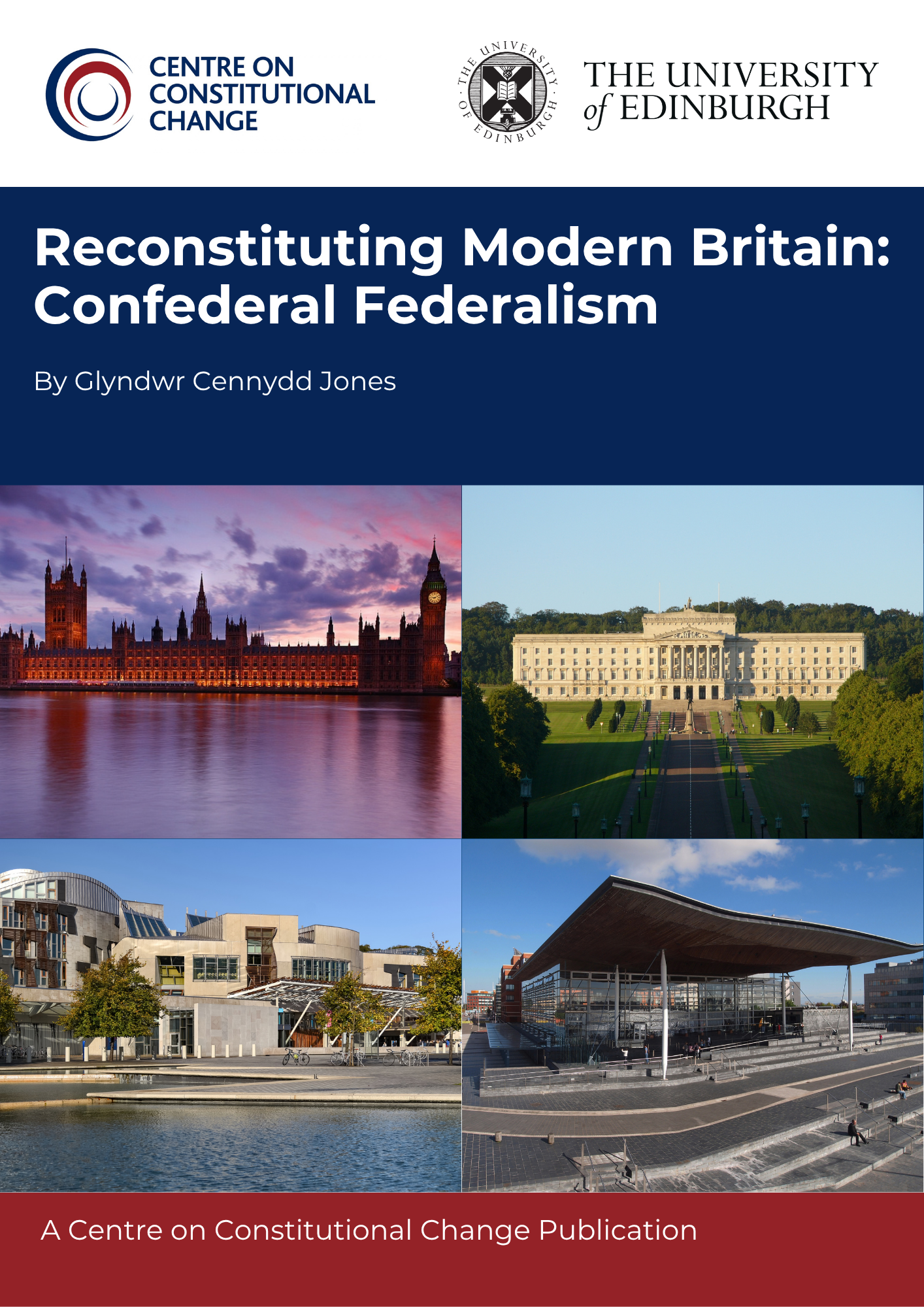
Reconstituting Modern Britain: Confederal Federalism, by Glyndwr Cennydd Jones
---
In his foreword to the essay Lord Carwyn Jones, Vice President of the Council of Europe and former First Minister of Wales, 2009-2018, writes:
‘In his essay, Glyndwr calls for a renewal of the relationship between the people of these islands and calls for a union made fit for purpose for the 21st Century. He recognises the close ties that exist between the people of Britain and the complexity existing in relations between political institutions.’
‘Too often the debate about the UK's future becomes a binary discussion as to whether the current union should be kept or whether it should come to an end… the debate is far more nuanced than that and this is why Glyndwr’s book is so timely.’
---
Glyndwr Cennydd Jones is a writer and commentator on constitutional matters and an advocate for a UK-wide constitutional commission. He has proposed a model of confederal federalism for governing inter-parliamentary relations across the isles and has released:
- Reconstituting Modern Britain: Confederal Federalism in October 2026 published by the Centre on Constitutional Change at the University of Edinburgh.
- Breaking Boundaries, Building Bridges in February 2026 at the European Union office in London alongside the EU Ambassador to the UK. This includes a foreword by Lord Vaizey of Didcot and discusses the value of cultural diplomacy globally.
- The Federal-Confederal Letters with David Melding CBE in 2025, through the Centre on Constitutional Change at Edinburgh University, the Federal Trust for Education and Research in London, and the Institute of Welsh Affairs (IWA), which includes a foreword by the Guardian journalist and author Will Hayward.
- A League-Union of the Isles: Constitutional Reflections - including a preface by Lord Carwyn Jones and an afterword by Lord David Owen - in 2022, again through the Centre on Constitutional Change, Federal Trust, and the IWA.
- Towards Federalism and Beyond and Brexit, Devolution and the Changing Union 2018 with Lord David Owen and Lord Elystan Morgan in 2017 and 2018 respectively, through the IWA.
---
Image Credits:
hozinja, CC BY 2.0, via Wikimedia Commons (Houses of Parliament at dusk)

https://www.flickr.com/photos/robertpaulyoung/, CC BY 2.0 , via Wikimedia Commons (Stormont)

Jorge Franganillo, CC BY 2.0, via Wikimedia Commons (Scottish Parliament)

User: (WT-shared) Cardiff at wts wikivoyage, Public domain, via Wikimedia Commons (Senedd Cymru, Welsh Parliament)
