
Building a loyal and stable political class: the Lega (Nord) in Italy
How does a party that began as a Northern Italian autonomist movement become a serious national political force? Summarising a recent article from Regional & Federal Studies, Sofia Marini and Gianluca Piccolino examine the Lega’s evolution through the career trajectories of its elected representatives, arguing that the composition of a party’s political class offers an important window onto its institutionalisation. Drawing on original data covering regional councillors and national MPs between 1990 and 2025, we find a strikingly uneven picture. In Northern Italy, the Lega has developed a highly stable and loyal political class, with most representatives building their careers within the party. Beyond its traditional heartlands, however, its expansion has relied much more heavily on newcomers and politicians recruited from other parties. The result is a party that is deeply institutionalised in the North but much less firmly rooted elsewhere—an unevenness that may help explain the organisational fragility and recent defections that have accompanied its transformation into a nationwide radical-right party.
Introduction
The Lega is currently the oldest Italian party with parliamentary representation. How has the Lega Nord, originally founded in 1989 as a coalition of autonomist parties from Northern Italy, become such a persistent actor in Italian politics?
On the one hand, this was due to important ideological rebranding. In terms of policy priorities, the key goal of the party shifted from full-fledges secession, to federalism, and finally to enhanced autonomy for the Northern regions. In ideological terms, the party increasingly adopted populist and radical themes, leading up to the transformation of the Lega Nord into Lega per Salvini Premier – a formally new party competing throughout Italy, with a markedly populist radical-right characterisation.
On the other hand, organizational evolutions helped the party build its own political class. Its electoral success and repeated government participation attracted new personnel and potential candidates. However, this process was particularly challenging in the regions where the party only expanded later. For a political party, it can be risky to incorporate ‘outsiders’, i.e. politicians not socialised within the same party. This holds particularly true in Italy, a context where the phenomenon of “party switching” is quite widespread.
Current political events confirm these trends: with electoral support for the Lega dropped below 10%, their MEP Roberto Vannacci founded a new party – Futuro Nazionale – that has attracted many defectors from the ranks of the Lega. This shows how building a loyal and stable political class is key for a party to thrive.
That is why, in a recent article published in Regional and Federal Studies, we suggest that the career patterns of elected representatives are an important indication of party institutionalisation. We consider parties to institutionalise when they are primarily based on elected officials who have developed their electoral career under the party’s banner. This signals that the party has organisational stability and a coherent ideological brand in which its elected representatives are socialised – both fundamental aspects of party institutionalisation.
Career patterns of elected representatives from the Lega (Nord)
To assess the extent to which the Lega is indeed an institutionalised actor, we rely on an original data collection of the careers of its politicians elected both at the regional and national level. We retrieved information about previous offices (local, regional, and national) and past party affiliations of elected representatives of the Lega, from 1990 to 2025. We used a variety of sources: mainly the Anagrafe degli Amministratori locali e Regionali del Ministero dell’Interno (Registry of Local and Regional Administrators of the Ministry of the Interior), but also the websites of the Camera dei Deputati and the Senato della Repubblica (Chamber of Deputies and Senate), complemented with significant biographical research.
Based on their previous affiliation, representatives were classified in different categories, to illustrate their characteristics. Those who have held no office in the previous 10 years are labelled as “newcomers”. Those who, at the time of the election, have only been affiliated with the Lega or any of its predecessor parties are labelled as “loyalists”. Finally, we distinguish between representatives elected for the Lega after having held past offices with another party between “switchers”, who had only been affiliated to other parties in the past, and “spurious”, who in the previous 10 years held both mandates with the Lega and with other party affiliations. The higher the share of loyalist, the more we can consider a party to be institutionalised.
Regional councillors (RCs)
Let us start from examining the career patterns of elected representatives of the Lega at the regional level. All Italian regions have their own assemblies and executives, despite some territorial differences in how exactly they are elected and operate. We begin from the regional level of representation because it has been key in the ideological profile of the Lega Nord. Furthermore, it is an important political arena for aspiring politicians, that proceed from elected offices at the local or regional level towards the national parliament.
Figure 1 shows the share of each career profile, by year and geographical area. There are important differences if we compare the Nord (panel A), where the Lega was founded and traditionally rooted, to the regions of the Centre and South (panels B and C, respectively), where the party only started contesting elections in the 2010s. In the North, after the first elections in the early 1990s, there was a growth and then a predominance of loyalists. This indicates a high level of institutionalization of the party.
Trends are less clear in the rest of Italy, though. In central Italy, the share of newcomers was higher in the second election, while the number of spurious RCs increased over time, indicating instability. In Southern regions, instead, the party relies heavily on switchers, showing a negligible number of loyalists.
Figure 1. Career patterns of Lega’s regional councillors, by area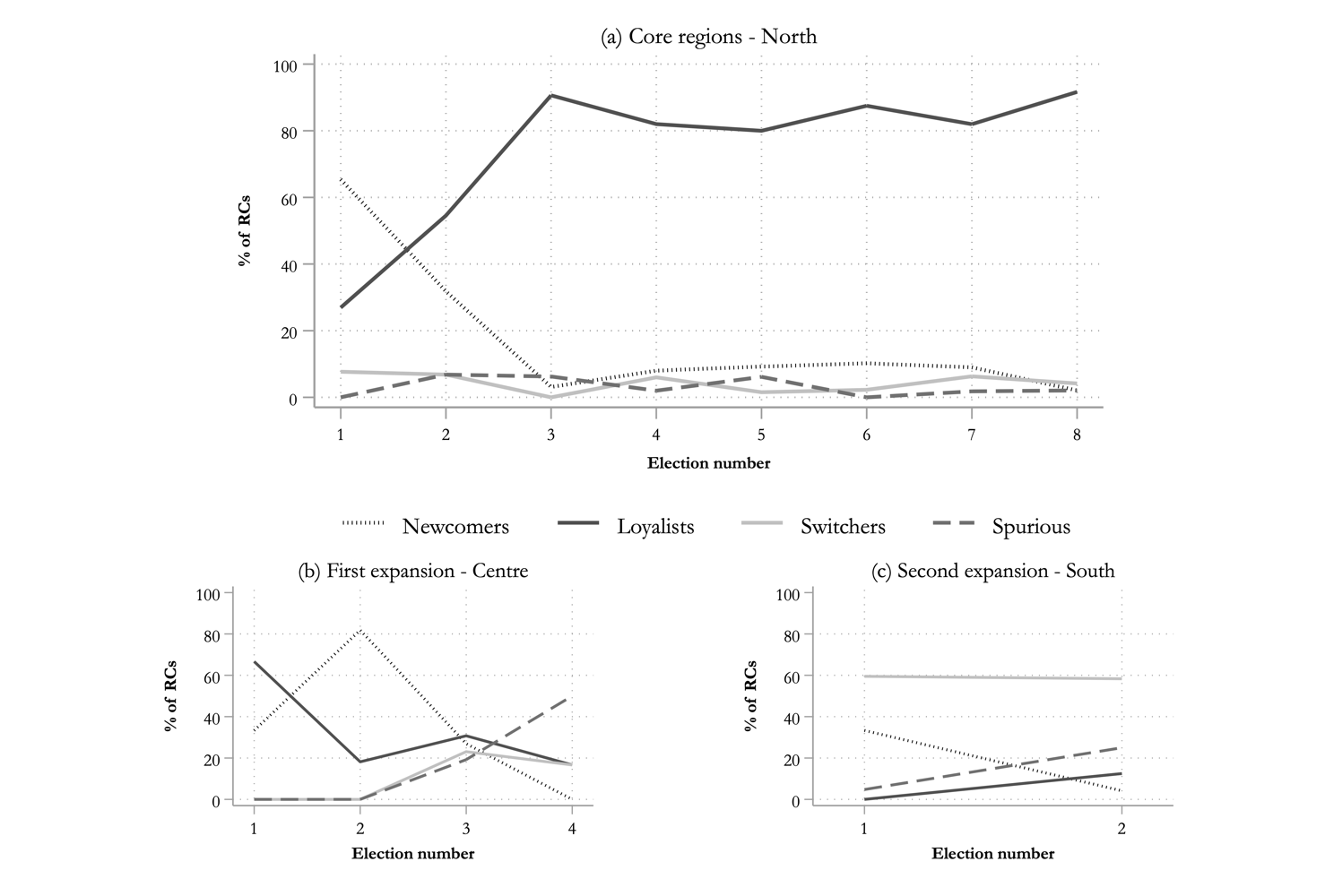
Members of Parliament (MPs)
Let us now move to the national level, to look at career patterns of MPs elected from the ranks of the Lega between 1992 and 2022.
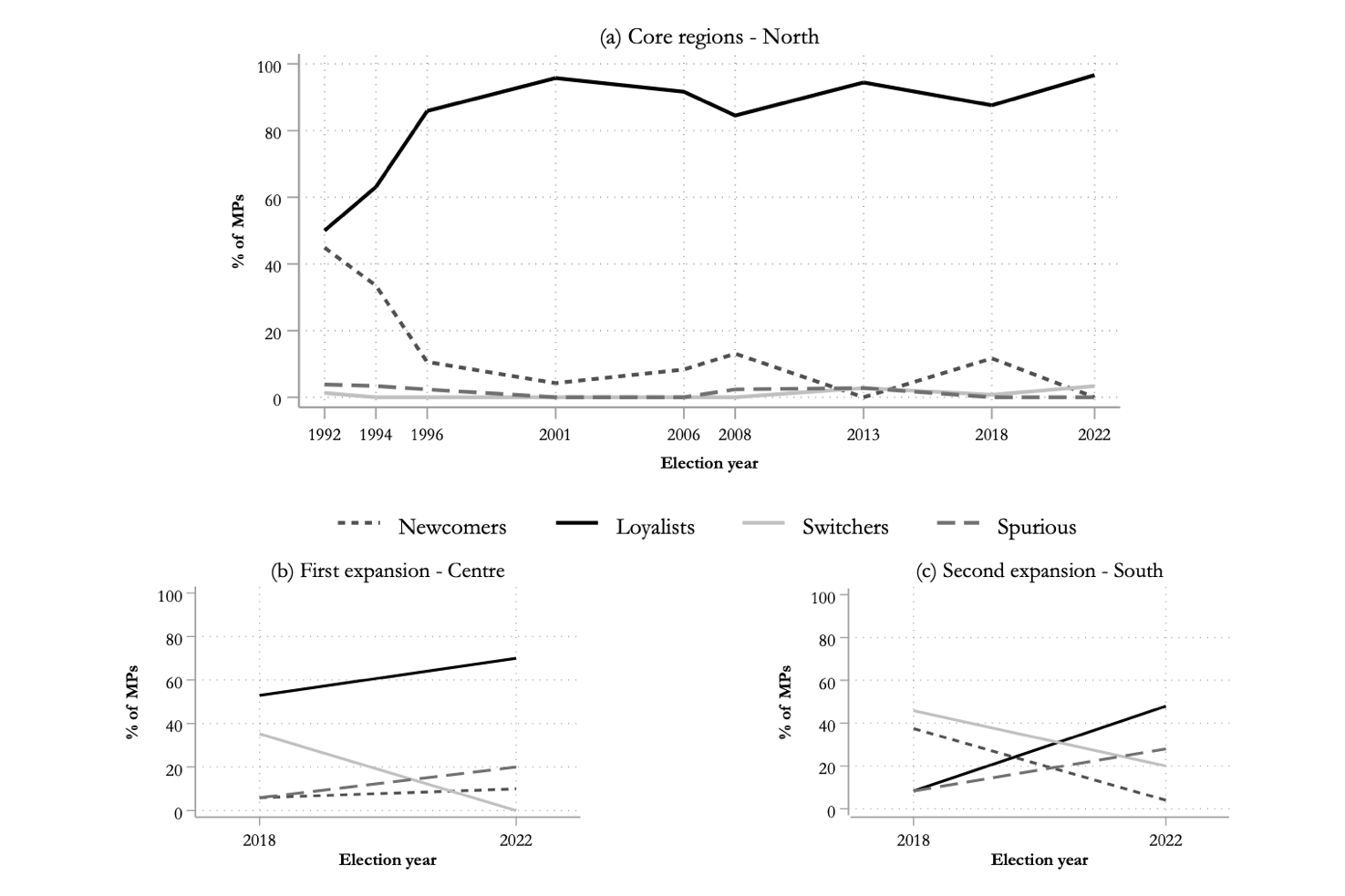
Again, for the Northern regions, we see clear evidence of institutionalisation, due to the rising share of loyalists, stably above 80% of elected MPs since 1996. After the 1990s, newcomers then remained stably below 10%, except for the years of electoral expansions, in which party lists might have been more open to recruitment of “fresh” candidates. The number of party switchers has instead remained low throughout this entire time frame.
MPs elected from other regions have very different profiles. In the Centre, where the party first expanded, switchers were about one third of elected MPs in 2018. Later on, the proportion of loyalists increased, suggesting some trend of institutionalisation. In the South, party switchers were endemic in the first election, amounting to nearly 46%, and remained around 20% in 2022. Although the increase in loyalists and drop in newcomers might suggest some institutionalisation, we are cautious in concluding so, because the share of loyalists still equals the share of spurious and switchers combined. We therefore conclude that no clear evidence of institutionalisation of the Lega emerges (yet?) from Southern Italy.
Figure 2. Career patterns of Lega’s members of parliament, by area
Conclusion
So, has the Lega managed to build a stable and loyal political class? Our coverage of different territorial areas between 1990 and 2025 paints a mixed picture.
In short, the profiles of elected representatives from the Lega are quite different, depending on the geographical area. The institutionalisation of the political class of the Lega that clearly emerges for the North does not hold for the rest of Italy, questioning its actual consolidation in the Centre-South. This raises several questions regarding the internal coexistence and ideological cohesion of these representatives within the party, as well as the impact it has on the image and performance of the party. In other words, it makes the institutionalisation of the party uneven across the different areas of the country. And indeed, the most recent splits from the Lega might be one of the consequences of a lower consolidation of the party beyond its electoral strongholds in the North.
---
Sofia Marini is post-doctoral researcher at the Department of Political Science of Aarhus University. Before that, she obtained her doctoral degree from the University of Vienna. Her main research interests lie in the field of comparative politics and include party organisation, party competition, and party change.
Gianluca Piccolino is a teaching assistant (cultore della materia) at the Department of Political and Social Sciences of the University of Florence.
---
Note: This article represents the views of the authors and not those of Regional & Federal Studies, the Centre on Constitutional Change, or the University of Edinburgh. It summarises this article from Regional & Federal Studies
Image credit: European Union via Wikimedia Commons.
.jpg)