
Institutional conflict in regional development: path dependence in the free trade zone and decentralization of Batam, Indonesia
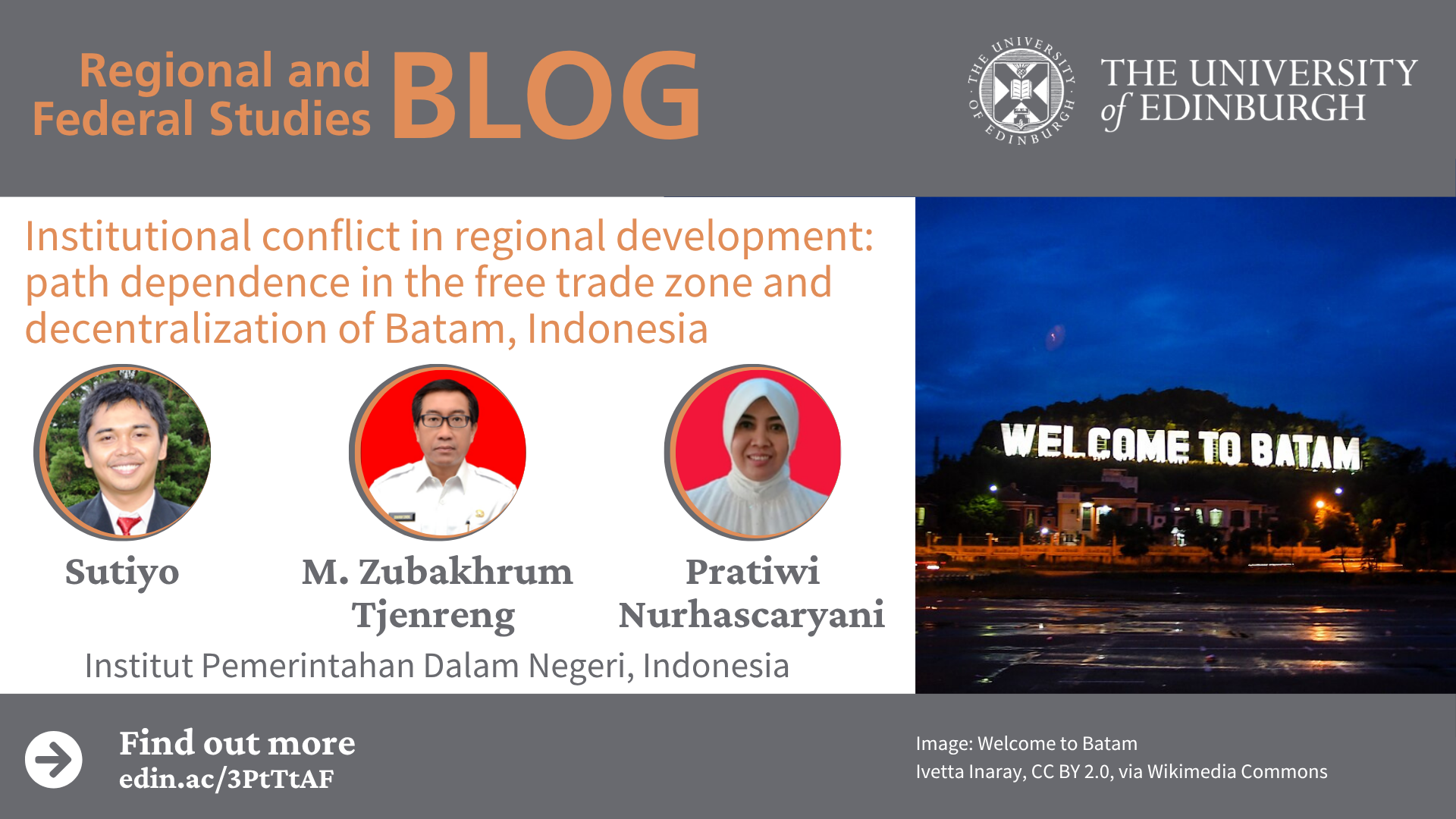
Summarising their recent article in Regional & Federal Studies, Sutiyo, M. Zubakhrum Tjenreng, and Pratiwi Nurhascaryani argue that regional development can become deeply complicated when multiple government institutions operate within the same territory without clearly defined authority. Focusing on Batam, the article explains how overlapping governance structures created during Indonesia’s decentralisation reforms produced long-term institutional conflict between the Batam Indonesia Free Zone Authority (BP Batam) and the city government. Using the perspective of historical institutionalism, the authors show how institutional layering and path dependence made reform increasingly difficult. The Batam case demonstrates that successful regional development depends not only on economic incentives and investment, but also on coherent institutional design.
Batam in Indonesia is often presented as one of the great development success stories. Located along the strategic Malacca Strait and closely connected to international trade routes, Batam was designed to become an industrial and investment hub. Over decades, the island attracted manufacturing industries, foreign investors, and large-scale infrastructure projects that transformed it into one of Indonesia’s most important economic zones. Yet, behind the economic growth lies a governance problem that has remained unresolved for more than two decades. Two government institutions operate within the same territory: the Batam Indonesia Free Zone Authority (BP Batam) and the Batam City Government. Both possess legal authority and political legitimacy, but they often pursue different priorities and governance approaches. The result has been a long-running institutional conflict that continues to shape Batam’s development.
The Origins of Batam’s Dual Governance
Batam’s transformation began in the early 1970s during the highly centralised administration of President Suharto. The government established the Batam Authority, previously known as Otorita Batam, to lead industrialisation and infrastructure development. The institution received extensive powers over land allocation, industrial planning, investment facilitation, and strategic infrastructure projects. Supported directly by the central government, Batam rapidly evolved into a major export-oriented manufacturing centre with strong economic links to Singapore and international markets.
Indonesia’s political landscape changed dramatically after the fall of Suharto in 1998. The country introduced decentralisation reforms aimed at strengthening local democracy and giving regional governments greater authority. In 1999, Batam became an autonomous city with its own mayor and local council. However, the earlier Batam Authority was not dissolved or merged into the new city government. Instead, both institutions continued operating side by side. In 2007, the government formally designated Batam as a Free Trade Zone and transformed Otorita Batam into BP Batam. Although the institution changed its name, it retained most of its authority, assets, and organisational structure.
Why the Conflict Persisted
The coexistence of BP Batam and the city government created overlapping authority and competing governance systems. BP Batam largely focused on national economic priorities such as industrial expansion, export competitiveness, infrastructure development, and attracting foreign investment. Meanwhile, the city government concentrated more on public services, local democracy, community aspirations, and political accountability. One of the most significant areas of conflict involved land management and licensing authority. BP Batam retained control over land allocation and strategic industrial zones, while the city government argued that local authorities should possess greater authority within their own territory. Both institutions relied on different legal interpretations and actively defended their respective powers. The authors explained the situation through the perspective of historical institutionalism, which examines how decisions made in the past continue shaping governance in the present. In Batam, the industrial authority created during Indonesia’s centralised era was never fully removed after decentralisation began. Instead, a new layer of local government was added on top of the existing structure.
This process is known as institutional layering. Rather than replacing the old institution, Indonesia created another institution with overlapping responsibilities inside the same territorial space. Over time, both BP Batam and the city government developed their own political support, bureaucratic systems, financial resources, and sources of legitimacy. As the arrangement continued, reform became increasingly difficult. This reflects the existence of path dependence, where earlier institutional decisions create long-term effects that are difficult to reverse. In Batam, both institutions accumulated enough influence and support to defend their continued existence, even when governance problems became more visible.
The Cost of Overlapping Institutions
The institutional rivalry in Batam has produced several practical consequences for governance and economic performance. Decision-making often became slower because policies required coordination between multiple agencies with different priorities. Investors also faced overlapping procedures and duplicated administrative requirements from both institutions. Licensing processes frequently became more complicated, costly, and time-consuming. At the same time, overlapping authority created legal uncertainty regarding which institution possessed final responsibility in certain areas. These conditions weakened governance efficiency and affected Batam’s attractiveness as an investment destination.
The Indonesian government introduced several initiatives to reduce institutional conflict. In 2009, authorities launched an integrated One-Stop Service system intended to simplify licensing and improve coordination. However, the reform produced limited results because both institutions continued operating under separate legal and bureaucratic frameworks. Another proposal emerged in 2015 when the Ministry of Home Affairs suggested dissolving BP Batam. The plan, however, faced resistance from ministries responsible for economic affairs, which viewed BP Batam as strategically important for national development. As a result, the proposal did not move forward.
A Partial Solution, Not a Final Resolution
A more significant reform occurred in 2019 when the Indonesian government unified the leadership of both institutions by appointing the Mayor of Batam as the ex-officio head of BP Batam. The arrangement improved coordination, accelerated delayed planning processes, and contributed to stronger economic performance. Nevertheless, important concerns remain regarding accountability, politicisation, and potential conflicts of interest. While unified leadership may reduce tensions in the short term, it does not fully eliminate the deeper structural overlap between the two institutions. The Batam case demonstrates that successful regional development depends not only on economic incentives and infrastructure investment, but also on clear institutional design. Overlapping institutions with competing mandates can create long-term governance problems that become increasingly difficult to resolve over time. For developing countries pursuing rapid economic growth, Batam offers an important reminder that effective development requires not only investment and ambition, but also coherent and well-aligned governance structures.
---
Sutiyo is an Associate Professor at Institut Pemerintahan Dalam Negeri (IPDN), a higher education institution under Indonesia’s Ministry of Home Affairs that specialises in educating future regional government leaders and civil servants. His research focuses on decentralisation, regional governance, rural development, and poverty alleviation.
M. Zubakhrum Tjenreng is a lecturer at Institut Pemerintahan Dalam Negeri, Indonesia. His academic interests focus on governance and public administration.
Pratiwi Nurhascaryani is a lecturer at Institut Pemerintahan Dalam Negeri, Indonesia. Her work focuses on governance and regional public policy issues.
---
Note: this blog represents the views of the author, and not those of Regional & Federal Studies, the Centre on Constitutional Change, or the University of Edinburgh. It summarises this RFS article.
Image credit: Ivetta Inaray CC BY 2.0, via Wikimedia Commons