
Beyond the Centre: A New Research Agenda for Constitutional Change
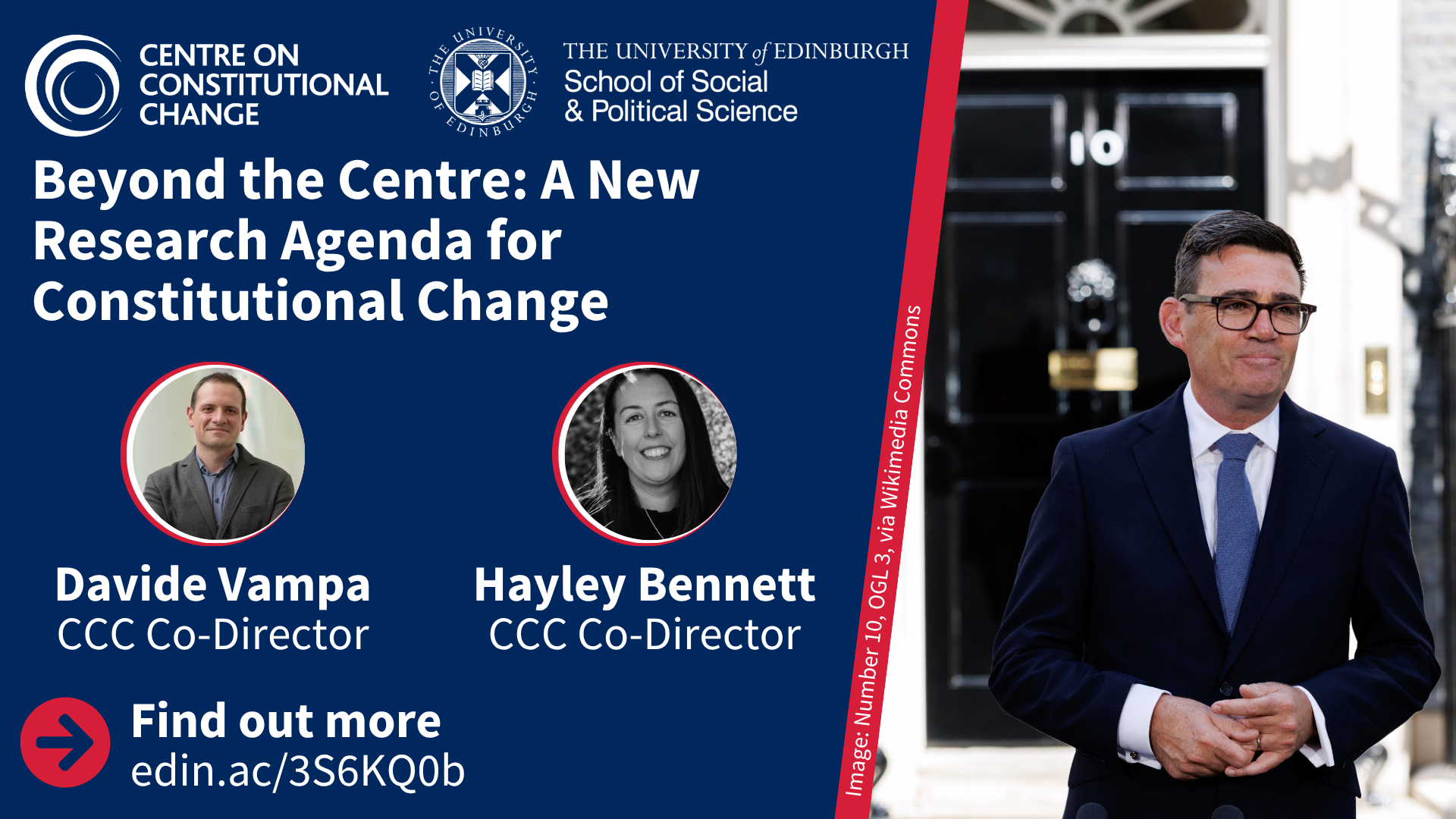
By Davide Vampa and Hayley Bennett,
Andy Burnham is not the first former mayor to enter Downing Street. But his experience of leading a devolved city-region outside London gives his premiership particular constitutional significance. Having spent years negotiating with Whitehall from Greater Manchester, he arrives at the centre of government with direct experience of the possibilities, constraints and unevenness of English devolution. His arrival also raises new questions about how devolved and subnational governance across the UK might evolve, and about the policy and institutional reforms that may follow. This moment demands more than commentary on the new government. It calls for sustained research into how power and place are being reconfigured across the United Kingdom.
The Centre on Constitutional Change therefore seeks to stimulate and support a new research agenda focused on a deceptively simple question: where does power go when it leaves the centre?
Devolution beyond the capitals
This question builds on the CCC’s recent work. Our 2025 report, Reinvigorating Devolution: Enhancing Central–Local Relations in Scotland, looked beyond transfers of power from Westminster to devolved institutions to examine how power is distributed within the nations of the UK. Devolution should be judged not only by the authority exercised in Edinburgh, Cardiff, Belfast or England’s city-regions, but also by whether it strengthens local democracy, reduces inequalities between places and social groups, and gives communities meaningful influence over the decisions that shape their lives.
Burnham’s programme brings these issues into sharper focus. Stronger English mayors could provide visible regional leadership, improve policy coordination and challenge Whitehall’s dominance. But mayoral devolution could also reinforce inequalities both between and within places. The best-organised and most economically powerful city-regions may gain greater resources and influence, while the benefits within them remain concentrated in urban cores. Rural and peripheral communities, as well as areas outside mayoral structures, may continue to struggle to be heard. Growing interest in mayoral and regional models in Scotland also raises questions about what can be learned from England – and what cannot simply be transplanted into a different institutional, political and geographical context.
The issue is not simply whether more power is devolved, but how far it travels and whose capacity to act it strengthens. What powers are transferred, to which institutions, with what resources and redistributive safeguards? How are those institutions held accountable, and how can citizens and communities shape their decisions? These questions matter both to the assessment of the Burnham government’s programme and to a wider research agenda on power and place across the UK.
Questions for a new research agenda
This changing territorial landscape raises six connected sets of questions.
First, where does devolved power ultimately reside? Does devolution genuinely disperse authority, or transfer it from one political centre to another – from Westminster to mayors or devolved governments, and from national capitals to regional executives? What roles remain for local government, communities and citizens? How does devolution affect democratic processes?
Second, can political devolution succeed without fiscal devolution? Burnham’s proposals give new urgency to questions about local revenue, needs-based redistribution and the relationship between autonomy and solidarity. Do devolved institutions have the resources and capacity to fulfil their responsibilities? Could greater fiscal autonomy widen inequalities between richer and poorer territories without effective redistribution? Is devolution without resources a form of risk-shifting?
Third, what institutional arrangements does English devolution require? England’s emerging settlement remains territorially uneven and constitutionally insecure. Key questions concern the accountability of mayors, the position of places outside mayoral structures, the relationship between combined authorities and councils, and the representation of England’s territories within central government. How have other countries balanced regional leadership, local autonomy, territorial coverage and representation at the centre, and what might England – and the wider UK – learn from their experience?
Fourth, how does territorial governance shape social policy and its outcomes? Devolution affects how public services are designed, coordinated and delivered. Housing, health and social care, transport, employment support and skills all involve relationships between different levels of government. Burnham’s experience of integrating services around place raises questions about whether devolution can support more responsive and preventative social policy – and whether territorial flexibility reduces inequalities or creates greater variation in provision, capacity and entitlement.
Fifth, what can the UK’s territories learn from one another? English combined authorities and mayors cannot simply be transplanted into Scotland, Wales or Northern Ireland. Each nation has its own geography, institutions and democratic traditions. Comparison can nevertheless illuminate shared problems, alternative approaches and the conditions under which reforms might succeed.
Finally, what do these changes mean for the Union? Devolution within England cannot be separated from relations among the four nations. New fiscal arrangements, territorial institutions and channels of representation will affect intergovernmental relations and the distribution of resources across the UK. If the government moves towards a written constitution, these questions will become more pressing still – issues explored in a blog series hosted by the CCC.
These questions connect constitutional change to the everyday experience of government. The issue is not only where powers formally reside, but whether different territorial arrangements improve public services, reduce inequalities and enable government to respond more effectively to the needs of different places.
How the CCC can contribute
The CCC is well placed to lead this research agenda by connecting fields of inquiry that are too often kept apart: English regional policy and territorial governance in Scotland; local democracy and the future of the Union; constitutional structures and social policy; fiscal arrangements and questions of identity, legitimacy and political trust.
Connecting these debates would allow reforms to be considered against common principles, including territorial equity, subsidiarity, fiscal capacity, democratic accountability, institutional durability and meaningful public participation. It could also encourage dialogue among researchers and between academic research and the experience of governments, councils, regional leaders, civil society and communities.
The CCC can also draw on its expertise in comparative territorial politics and policy to place developments in the UK within a wider international context. This international scope is strengthened by our close collaboration with the leading journal Regional & Federal Studies and by the journal’s active blog we host, which translates academic research for a wider audience. Multi-level systems elsewhere have confronted similar challenges: combining autonomy with redistribution, managing relationships between levels of government, accommodating asymmetry, and preventing decentralisation from reproducing inequalities or creating new concentrations of power.
International comparison does not provide models that can simply be imported into the UK. It can, however, illuminate alternative choices, identify the conditions under which reforms have proved effective, and reveal risks that may be less visible when the UK is considered in isolation.
The CCC’s contribution rests on its established strengths: rigorous and independent analysis, comparison within and beyond the UK, and the creation of spaces in which different perspectives can be tested against evidence. It can connect the formal distribution of power to institutional and policy capacity, social and territorial outcomes, and the ways citizens experience government in different places.
The purpose is not to endorse or oppose the Burnham government’s programme, nor to prescribe a single model for every part of the UK. It is to deepen understanding of what meaningful devolution and localisation require, what success might look like, where reform may be succeeding or falling short, and what its consequences may be for the state and its citizens.
A new prime minister may open a window for constitutional change, but political intent alone will not determine what comes through it. Whether this opportunity produces a more balanced, democratic and durable distribution of power will depend on choices made across the UK – and on whether constitutional reform is connected to the resources, institutions and public policies through which power becomes meaningful in people’s lives.
The CCC can help inform those choices and broker advanced discussion through evidence, comparison and sustained critical debate, drawing lessons from across the UK and other territorially diverse democracies.