The Centre on Constitutional Change is a leading hub for the comparative study of territorial politics and governance in the United Kingdom and beyond.
Fiscal decentralisation promises to bring government closer to citizens and reduce regional inequalities, but its success depends on the institutions receiving these powers. Drawing on departmental data from Colombia between 2005 and 2020, Jaime E. Ávila-Álvarez, Beatriz Cuadrado-Ballesteros, and Jennifer Martínez-Ferrero examine how armed conflict and corruption undermine these ambitions, allowing public resources to be captured by armed groups and local elites.
As devolved nations act as laboratories for democratic reform, Westminster should pay close attention to their experiments
France’s 2014 territorial reform redrew regional boundaries while preserving departments, despite longstanding calls for their abolition. Patrick Le Lidec argues that this choice reflected the unequal political protection enjoyed by different levels of government. Institutions with stronger protection could both resist restructuring and help redirect reform towards a more exposed tier.
Michael Keating responds to the recent meeting of the leaders of Sinn Féin, Plaid Cymru and the SNP
Why do independence movements win overwhelming support nearly everywhere except in wealthy democracies of the global North?
Studies of UK social policies that fail to understand the multi-level competencies and policy differences of England, Wales, Scotland and Northern Ireland may contribute to creating a ‘scalar fallacy’ of a single and unified UK welfare state.
To what extent has Catalan society depolarized over the national question after the failed 2017 push for unilateral secession? And what factors have shaped the evolution of depolarization in Catalonia?
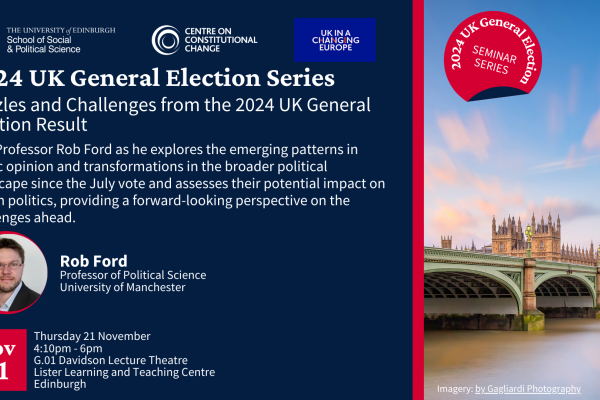
In this session, Professor Rob Ford will reflect on the surprising elements and long-term implications of the 2024 UK General Election.
This website uses Google Analytics to gather usage statistics. Please accept or reject. See our privacy policy.